Statement of Mindanao Climate Justice (MCJ)
International Day of Forests — 21 March 2026
Defend Mindanao’s Forests: Not a Frontier for Extraction
Across Mindanao, communities are already experiencing the loss of forests—in their homes, on their farms, and in their daily lives.
Floodwaters rise faster. Crops are damaged. Water sources decline. Fish catch weakens. Livelihoods become more uncertain.
Farmers, Indigenous Peoples, and rural communities face these realities every day as forests that once protected watersheds and sustained life are cleared for plantations, mining, logging, infrastructure, and other forms of land conversion.
As forests disappear, people bear the burden—through damaged farms, unstable harvests, polluted rivers, and increasing vulnerability to disasters.
On the International Day of Forests, Mindanao Climate Justice (MCJ) calls attention to how these pressures are reshaping the island’s remaining forest landscapes.
Mindanao has long been described as the Philippines’ “last frontier”—one of the country’s remaining strongholds of forests and biodiversity. But for many communities, this “frontier” has meant something else: land opened up for extraction, where corporations expand and profit, while communities lose land, livelihood, and security.
Today, this “last frontier” is also the frontline of deforestation—and of struggle.
The contradiction is stark in Bukidnon. The province spans 1,049,858 hectares, with 650,912 hectares or 62% classified as forestland. Yet only about 213,066 hectares of natural forest remain—roughly a quarter of its original forest cover. At the same time, 63.23% of land use is already devoted to crop cultivation, as Bukidnon serves as the food basket of Northern Mindanao, contributing 66.4% of crop production, 60.9% of livestock, and 47.9% of poultry value.
This reveals a deeper crisis: the very expansion of agriculture that sustains the region’s economy is also eroding the ecological systems—forests, watersheds, and soils—that make that productivity possible.
The impacts extend beyond upland farms. In Misamis Oriental, only about 59,783 hectares of forest remain, including just 474 hectares of mangroves, out of a total land area of 313,152 hectares. These remaining forests sustain watersheds that flow into Macajalar and Gingoog Bays, where fisherfolk depend on coastal and marine resources. As deforestation accelerates, erosion and siltation damage rivers and coastal ecosystems, reducing fish catch and threatening livelihoods downstream.
In Lanao del Sur, forest loss threatens not only ecosystems but culture and survival. Around 149,263 hectares of forest remain, largely within the Lake Lanao watershed, which covers about 102,088 hectares of forestland, with around 78,826 hectares still forested. The broader Agus–Lake Lanao watershed spans 192,656 hectares and supports hydropower systems that supply 33% of Mindanao’s energy, with seven hydroelectric plants generating around 727 megawatts.
Forest degradation in this watershed is not only an environmental issue—it directly affects water security, energy systems, and the cultural life of the Maranao people.
Further east, the Eastern Mindanao Biodiversity Corridor (EMBC)—spanning about 2 million hectares across CARAGA and the Davao Region—remains one of the country’s most important ecological zones. It includes watersheds of at least 22 river systems and significant remaining forest blocks across Agusan del Sur, Surigao del Sur, and Davao Oriental.
Yet the pressure is immense: about 41% of the corridor, or roughly 873,600 hectares, is already degraded or classified as secondary forest. While 1,126,400 hectares remain as natural forests and plantations, the continued expansion of extractive activities threatens even these remaining ecosystems.
Across these landscapes, the pattern is clear.
This is not simply a problem of forest loss—it is a result of a system that turns forests into profit, while communities bear the costs through displacement, disaster, and the loss of livelihood.
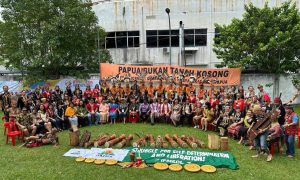
For Indigenous Peoples, these forests are not empty lands—they are ancestral domains, sources of food, culture, and identity. In Bukidnon alone, mountain ranges such as Kitanglad, Kalatungan, Pantaron, and Tago are home to multiple Indigenous groups, including the Higaonon, Talaandig, Manobo, Bukidnon, Matigsalug, Tigwahanon, and Umayamnon.
Across Mindanao, Lumad communities continue to defend forests such as the Pantaron Range through collective stewardship.
Yet these same communities face displacement, militarization, and the erosion of their rights as their lands are opened to external control.
The destruction of forests is inseparable from the struggle for land, rights, and self-determination.
As forests decline, vulnerability deepens. Floods intensify, harvests become unstable, and communities face growing uncertainty in the face of climate change.
Mindanao’s forests are not empty frontiers.
They are lived in, defended, and sustained by the people.
We must act together:
- Halt destructive land conversion in forest and watershed areas
- Protect and restore critical forest landscapes across Mindanao
- Uphold Indigenous Peoples’ rights to ancestral domains and self-governance
- Hold corporations and state actors accountable for environmental destruction and displacement
- Strengthen community-based forest governance rooted in Indigenous knowledge systems
Forests for life, not for profit.
Not a frontier for extraction—but a territory of life.
Defend the forests. Defend the people. Defend Mindanao.