10 December 2025 – UP Malcolm Hall, UP College of Law
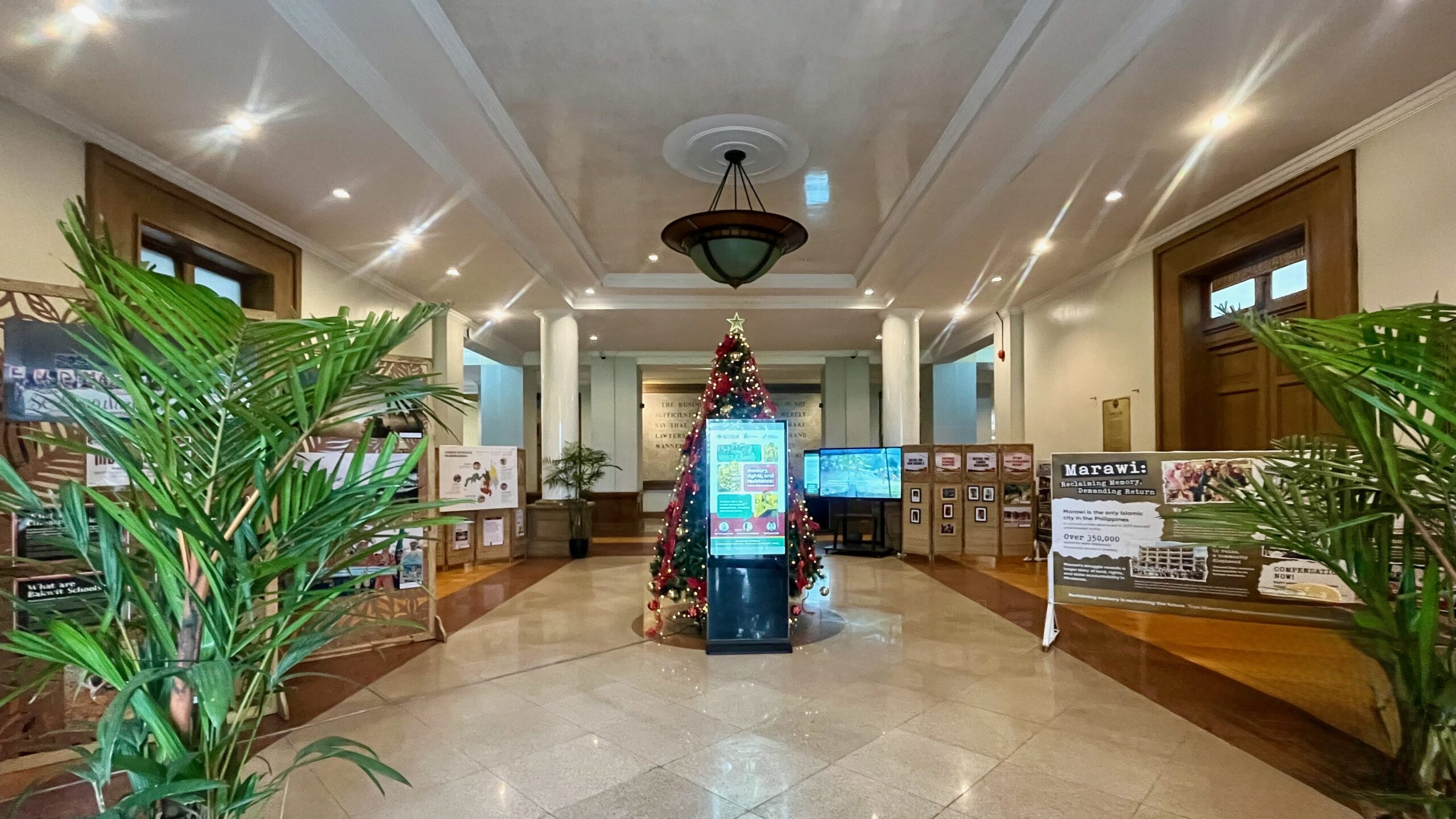
The University of the Philippines Institute of Human Rights (UP-IHR), in partnership with Mindanao Climate Justice (MCJ), opened the exhibit “Memory, Rights, and Resistance: Stories from Mindanao” on International Human Rights Day—a people’s archive on land, displacement, and climate justice grounded in the lived struggles of Lumad and Moro communities.
What began as Museo Lumad, an initiative to preserve Lumad educational histories, expanded into a broader exhibit on Mindanao memory, human rights, and community-led climate justice. The exhibit now interweaves four major narratives—Marawi, Bukidnon, Lumad Schools, and the Talaingod 13—to show how land, education, culture, and climate justice are deeply interconnected.
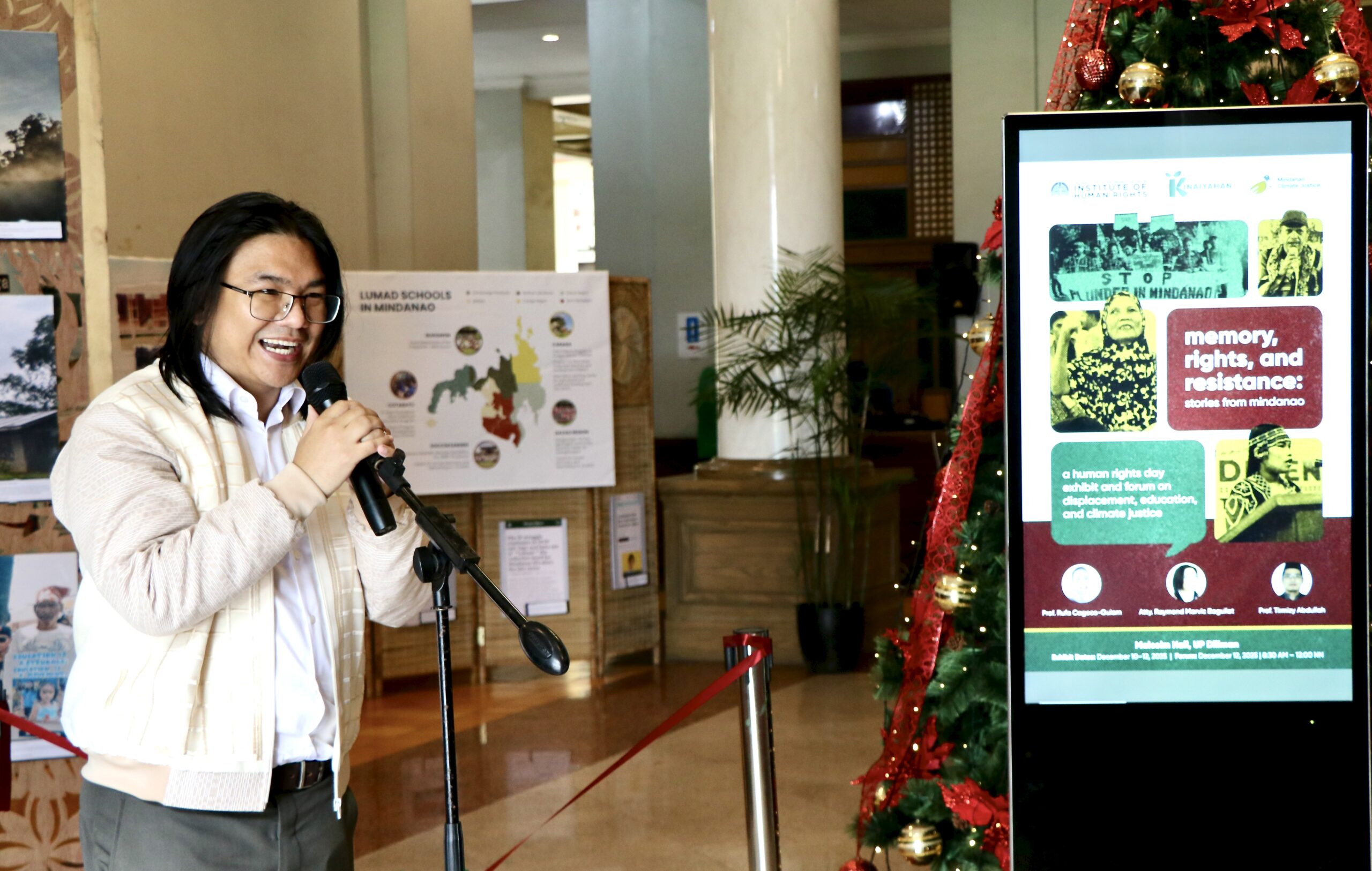
Before the program formally began, Dean Gwen Grecia-De Vera of the UP College of Law welcomed community delegates from Bukidnon, Marawi, and the Lumad community. Their stories and struggles are featured at the heart of the “Memory, Rights, and Resistance” exhibit.
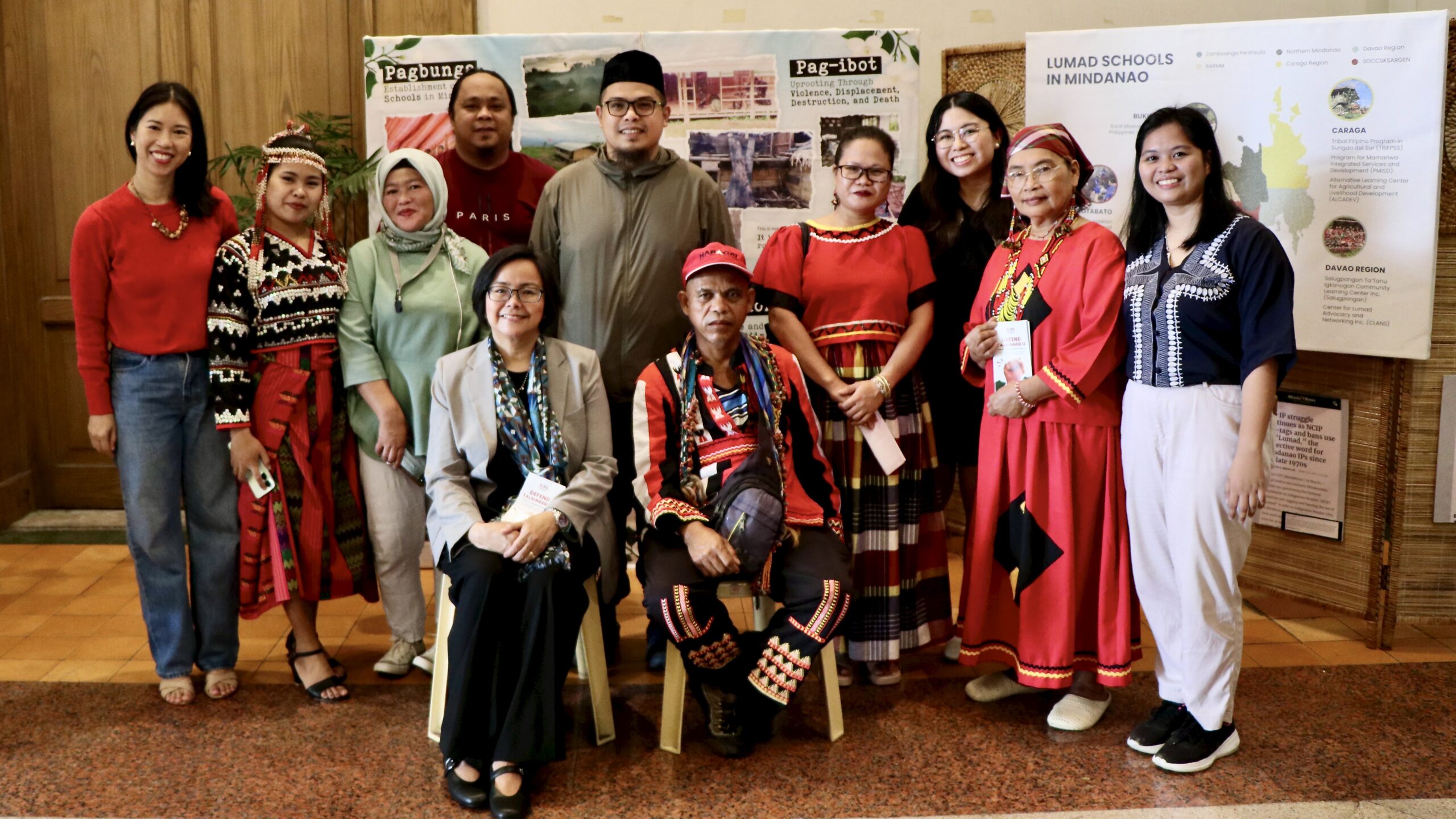
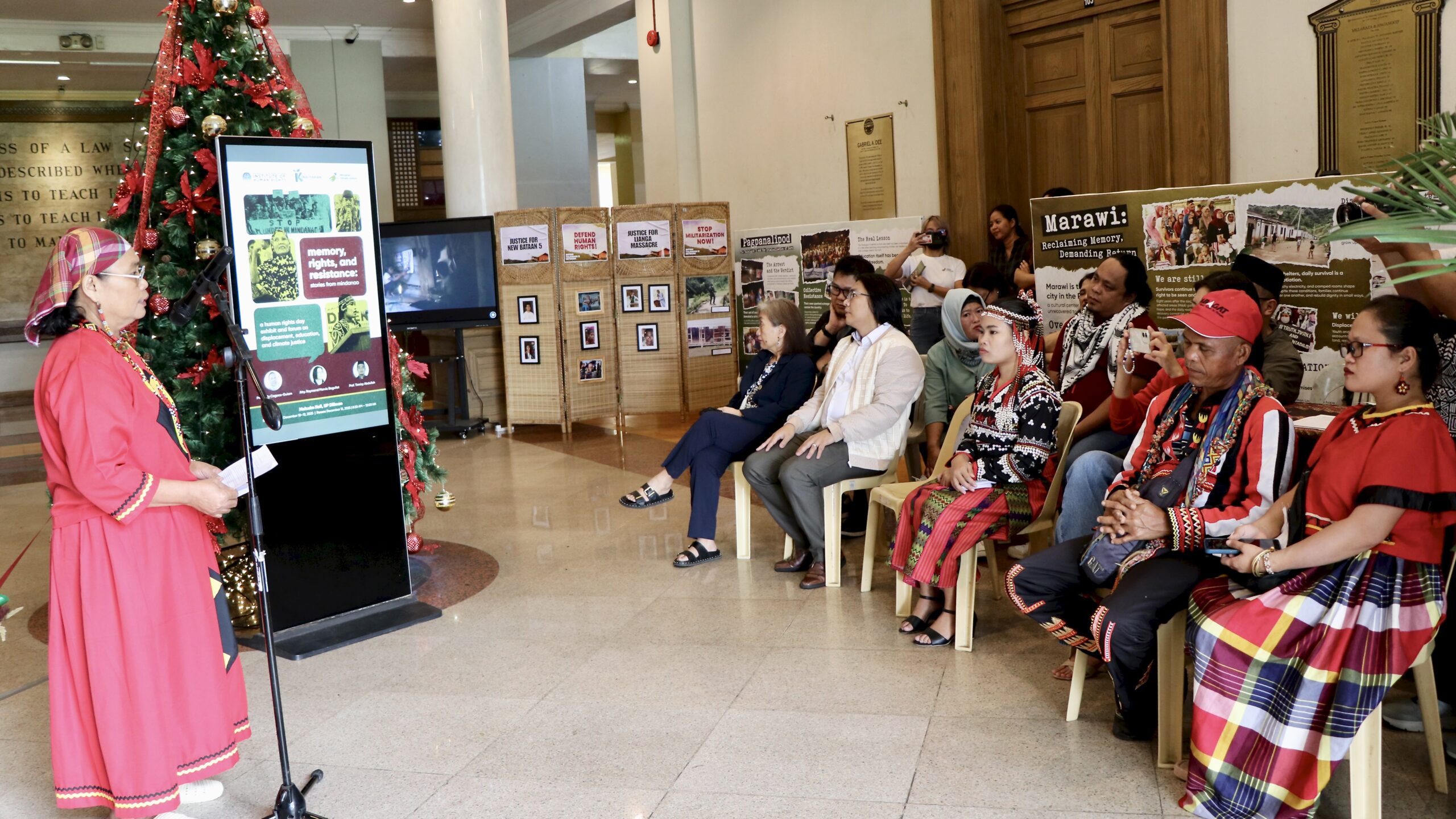
In her opening remarks, Lumad Manobo leader Eufemia “Ka Fem” Cullamat framed the gathering as an assertion of collective memory and identity:
“Ang Museo Lumad ay likha ng Lumad, nagmumula sa Lumad, at para sa Lumad. Pero ngayon, ang kwento ay Mindanao—ang aming mga alaala, aming mga sugat, at aming patuloy na paglaban.”
Marawi: Displacement, Memory, and Climate Vulnerability
Brought to life through the voices of Mu-Ahz Omar, Hanifah Pangcoga, and Dr. Tirmizy Abdullah
Eight years after the 2017 siege, thousands of Maranao families remain unable to return home. The exhibit panel on Marawi highlights how displacement cuts across generations: homes lost, mosques destroyed, archives erased, and families resettled in overcrowded, flood-prone relocation sites.
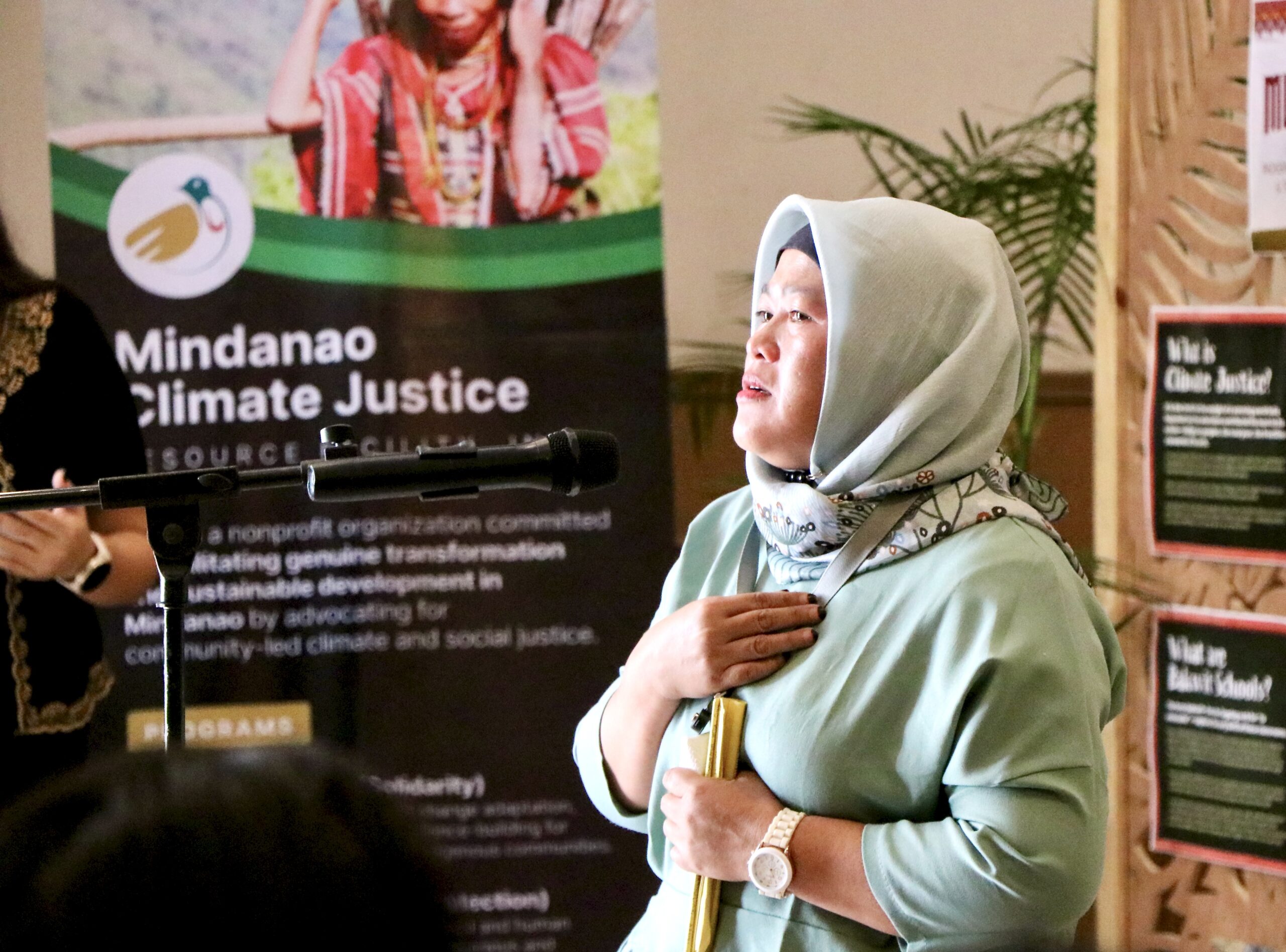
During the program, Mu-Ahz P. Omar of the Reclaim Marawi Movement spoke of the painful invisibility experienced by the community:
“Akala namin, nakalimutan na ang Marawi. Wala na kasi ito sa social media o mainstream media. Marami ang nag-aakalang maayos na ang Marawi matapos ang walong taon— pero malayo iyon sa katotohanan.”
His testimony was followed by Hanifah Pangcoga, who shared the emotional burden borne by mothers and families still yearning for return, and by Dr. Tirmizy Abdullah, who affirmed that the struggle for Marawi is a struggle for dignity, historical truth, and reparative justice.
Bukidnon: Watersheds, Land Grabs, and Climate Injustice
Affirmed by the message of Datu Rolando Anglao
The Bukidnon section of the exhibit focuses on land grabbing, watershed encroachment, agribusiness expansion, and “green” projects that displace Indigenous communities under the guise of conservation and carbon-offsetting.
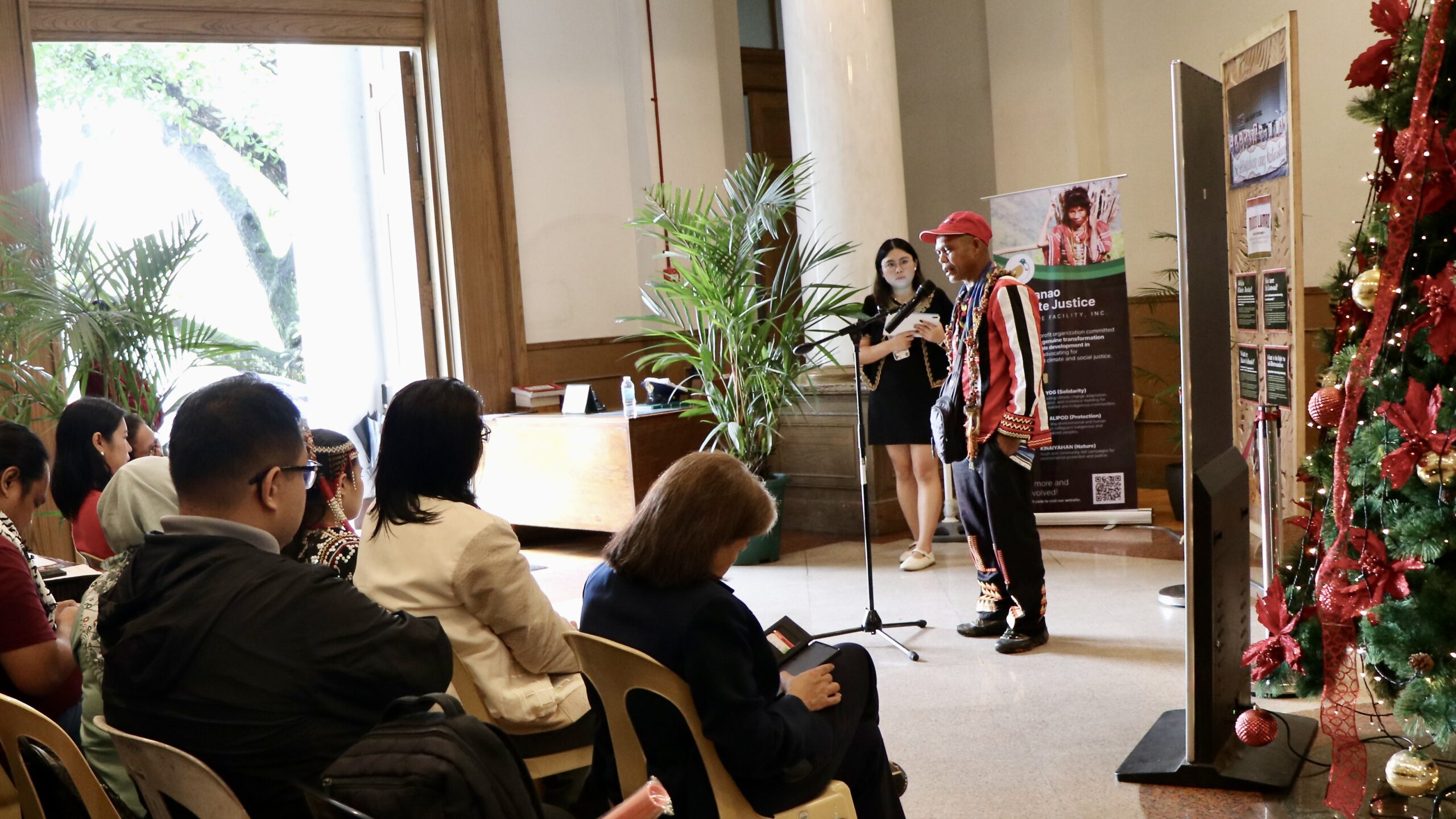
When Datu Rolando Anglao spoke during the program, the exhibit’s message took on immediate emotional force. He reflected on how communities are frequently devalued and dehumanized in their struggle to protect their ancestral domain:
“Napakahalaga ng mga espasyong tulad nito. Madalas sa karanasan namin, pakiramdam namin ay tinatrato kaming walang halaga. Kung wala ang mga taong handang makinig at tumulong, baka hindi na kami nagpatuloy. Lakas namin ang suporta ng mga kasama naming naninindigan para sa aming lupang ninuno.”
His words affirmed the exhibit’s thesis: real climate justice is built on Indigenous sovereignty, not corporate-led climate schemes.
Lumad Schools & the Talaingod 13: Defending Education, Defending Life
The culminating narrative of the exhibit
The final panels return to the origins of the project: the story of Lumad schools and the criminalization of their defenders.
Lumad schools taught not only literacy but also sustainable agriculture, watershed care, and ecological knowledge—community-designed climate education rooted in land and culture.
Yet more than 200 Lumad schools were forcibly shut down. Teachers were vilified. Youth were displaced.
The accompanying panel on the Talaingod 13 reveals how those who protected Lumad children during militarization were later arrested and convicted—an emblematic case of lawfare against educators and environmental defenders.
These panels form the emotional crescendo of the exhibit, reminding visitors that the right to learn, the right to land, and the right to live free from violence are inseparable.
Closing: Atty. Ice’s Call to Future Lawyers, and Angelika’s Dance of Solidarity
The program concluded with closing remarks from Atty. Raymond Marvic “Ice” Baguilat, Head of UP-IHR’s Indigenous Peoples Law and Policy Program. Reflecting on the limits yet importance of exhibits and public memory work, he emphasized:
“Alam nating maliit na bagay lamang ang isang exhibit kumpara sa napakaraming inhustisyang naranasan ninyo. Wala tayong ilusyon na bigla nitong mababago ang sitwasyon. Ngunit ang iniaalok natin dito ay pag-asa.
At kung makumbinsi man lang natin ang kahit isang law student na makakita ng exhibit na ito na maging abogado para sa katarungan, sapat na iyon. Higit pa—kung mas marami pa ang mahikayat nating magsilbi sa bayan at manindigan para sa karapatan—masasabi nating nagtagumpay tayo.”
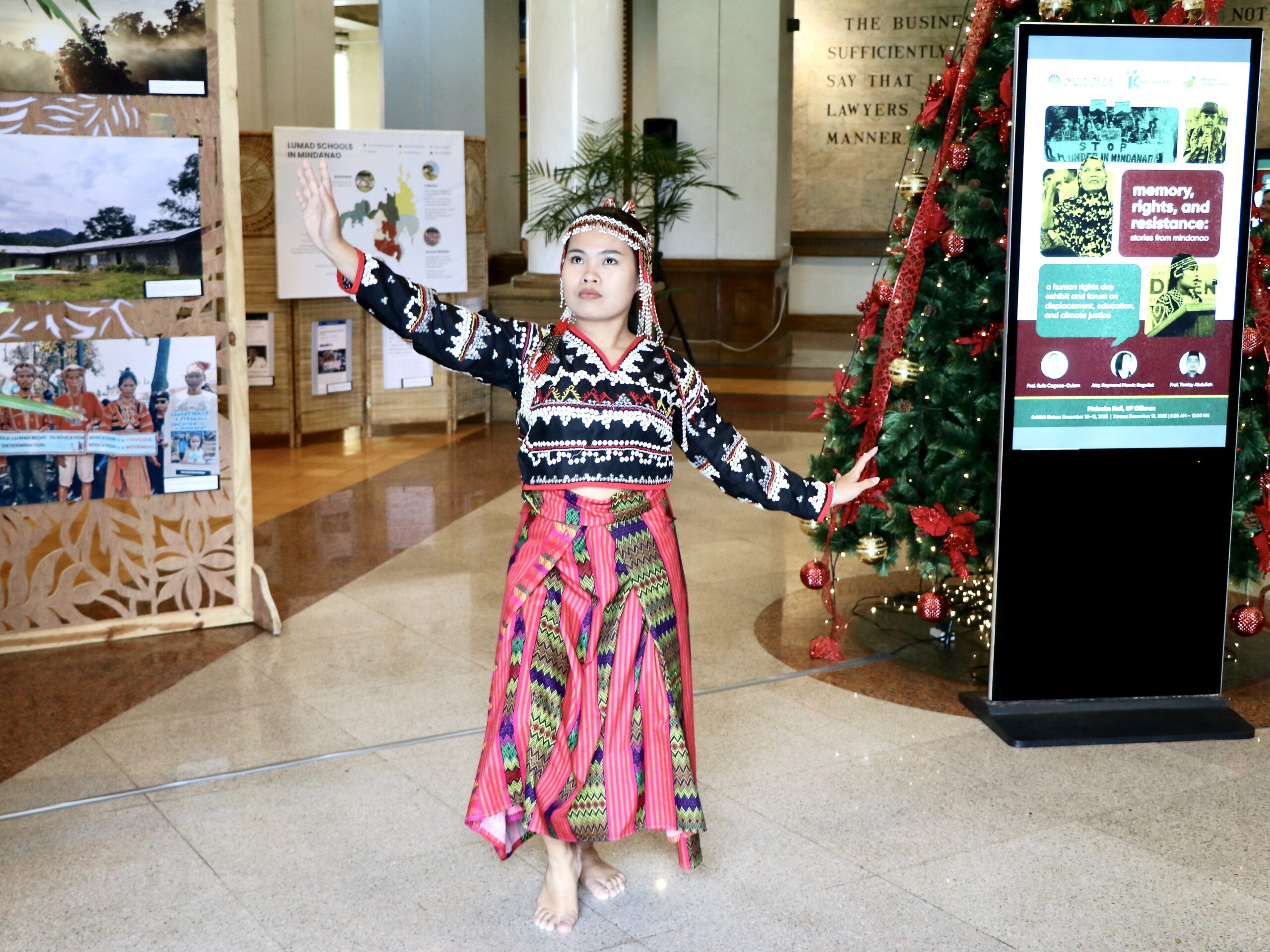
The ceremony ended with a solidarity dance by Angelika Moral, a B’laan youth leader and former Lumad school student. Her performance honored the communities whose stories anchor the exhibit—an embodied affirmation of survival, resilience, and hope.
Why This Exhibit Matters
By bringing together Marawi, Bukidnon, Lumad Schools, and the Talaingod 13, the exhibit presents a unified truth: Climate justice is people’s justice.
It lives in ancestral lands, in classrooms, in memories of siege and displacement, and in the courage of communities who refuse to be erased.
The exhibit’s final words echo across the hall:
Memory is resistance.
Memory is climate justice.
Memory is where justice begins.
Call to Action
The exhibit calls on the public to:
1. Defend Indigenous Education
Support Lumad schools and community learning spaces grounded in ecological knowledge and cultural memory.
2. Stand with the Talaingod 13
Recognize the criminalization of educators and land defenders, and uphold the right to teach and protect communities without fear.
3. Uphold the Right to Return for Marawi
Support Maranao families seeking justice, reparations, and meaningful reconstruction after eight years of displacement.
4. Support Land Defenders in Bukidnon
Stand with Indigenous communities resisting land grabbing, militarization, and greenwashing.
5. Reject False Climate Solutions
Critically examine carbon projects and “conservation” schemes that dispossess communities.
6. Keep Memory Alive
Share these stories in classrooms, networks, and public spaces; memory is a tool of resistance.
7. Engage in Campaigns, Research, and Solidarity Work
Contribute to efforts that uphold land, life, and climate justice from the ground up.
Stand with Lumad and Moro communities.
Defend land, life, and memory.
Climate justice begins with us.
Photo Credits & Acknowledgment
Most photos in this article are courtesy of the UP Institute of Human Rights (UP IHR), UP College of Law. MCJ also extend their gratitude to the UP College of Law for generously hosting the exhibit at Malcolm Hall, and to the UP IHR volunteers and staff whose support made the installation and documentation of “Memory, Rights, and Resistance” possible.