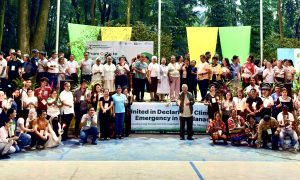
Peace in Limbo, Justice Deferred
The Unfinished Promise of the Bangsamoro Peace Process
Statement of Mindanao Climate Justice (MCJ)
Bangsamoro Freedom Day / Day of Shuhada — 18 March 2026
Across the Bangsamoro homeland, the promise of peace remains unfinished. Communities that endured decades of armed conflict continue to face poverty, displacement, and deep social inequality, while many of the commitments intended to secure lasting peace remain incomplete.
On Bangsamoro Freedom Day, Mindanao Climate Justice (MCJ) calls attention to the growing uncertainty surrounding the implementation of the Bangsamoro peace process. More than a decade after the signing of the Comprehensive Agreement on the Bangsamoro between the Philippine government and the Moro Islamic Liberation Front, several key commitments meant to support recovery, development, and meaningful autonomy remain unfinished.
Peace agreements may silence guns, but peace cannot endure if justice, land, and dignity remain out of reach for the peoples who suffered the most from war.
Delays in implementation, weak social investments, and decision-making processes distant from affected communities risk pushing the peace process into a dangerous period of uncertainty. If these conditions persist, the gains achieved through decades of struggle and negotiation may slowly drift into political limbo.
When justice is deferred, peace itself falls into limbo.
March 18 is observed in the Bangsamoro Autonomous Region in Muslim Mindanao as Bangsamoro Freedom Day and the Day of Shuhada, or Day of Martyrs. The date honors those who sacrificed their lives in the Bangsamoro struggle for dignity, justice, and the right to self-determination.
It also marks the remembrance of the Jabidah Massacre on Corregidor Island in 1968 during the dictatorship of Ferdinand Marcos Sr., when Moro recruits were killed after protesting the harsh conditions of a covert military operation. The massacre exposed deep grievances over land dispossession, discrimination, and political exclusion experienced by Muslim peoples across Mindanao and the Sulu archipelago.
For many Bangsamoro communities, Jabidah symbolized a turning point that brought national attention to their struggle for recognition, autonomy, and justice. More than five decades later, the injustices that ignited the Bangsamoro struggle—land dispossession, political exclusion, and uneven development—remain unresolved in many communities.
The Bangsamoro struggle has never been only about autonomy in law—it has always been about dignity, land, and the right of communities to shape their own future.
Decades of armed conflict followed, leaving deep wounds across the region and displacing countless families. Peace negotiations later sought to address these injustices through political settlement rather than continued war. Yet the conditions across the Bangsamoro homeland today show how incomplete that transformation remains.
According to the Philippine Statistics Authority, poverty incidence in the Bangsamoro Autonomous Region in Muslim Mindanao stands at about 39.4 percent, the highest in the country and more than double the national average. In several provinces—including Sulu, Basilan, and Maguindanao—poverty levels have long exceeded 40 percent, reflecting the enduring social costs of war, displacement, marginalization, and decades of uneven development.
Education indicators reveal similar challenges. The Comprehensive Rapid Literacy Assessment for School Year 2025–2026 shows that several Bangsamoro provinces have among the highest percentages of struggling readers nationwide. Tawi-Tawi recorded 75.6 percent, while Maguindanao del Norte recorded 65.38 percent. Sulu, Basilan, and Maguindanao del Sur also rank among the most affected.
The scars of conflict remain visible in communities still recovering from displacement. The 2017 Siege of Marawi forced more than 200,000 residents to flee their homes, creating one of the largest internal displacements in recent Philippine history. Nearly a decade later, many families continue rebuilding homes, livelihoods, and communities.
At the same time, floods, landslides, and extreme weather events intensified by climate change continue to force communities to evacuate. Humanitarian monitoring has recorded more than 120,000 people displaced in recent years due to a combination of conflict and disasters, many of them in the Bangsamoro region. For many families, evacuation has become a repeated reality—first because of war, and increasingly because of climate disasters.
The struggle for peace is closely tied to struggles over land, resources, and environmental protection. Forests, watersheds, and ancestral lands face increasing pressure from mining expansion, plantation agriculture, and large-scale development projects that prioritize profit over communities and ecosystems.
For many communities, peace is not only a political question. It is also a struggle for land, livelihood, dignity, and environmental security.
Throughout the island, Moro, Lumad, and Christian communities—the tri-people of Mindanao—share the same lands, rivers, forests, and watersheds that sustain life across the region. Their futures are interconnected.
Peace in the Bangsamoro homeland is inseparable from peace across Mindanao, because Moro, Lumad, and Christian communities share the same lands, waters, and future.
Safeguarding peace therefore requires more than signed agreements. It requires sustained investments in education, livelihoods, public services, and climate-resilient development, as well as genuine protection of land, ancestral domains, forests, and watersheds that sustain communities.
The gains of the Bangsamoro peace process must not be allowed to drift into uncertainty or be decided far from the communities whose lives depend on it.
On this Bangsamoro Freedom Day and Day of Shuhada, Mindanao Climate Justice calls on citizens, churches, civil society organizations, and policymakers to stand with Bangsamoro communities in defending the integrity of the peace process and ensuring that its promises translate into justice, dignity, and security for the people.
The promise of peace must not be allowed to fade into uncertainty.
Remember Jabidah.
Honor the martyrs of the Bangsamoro struggle.
Stand together—Moro, Lumad, and Christian—to defend the peace before justice is deferred once again.