Protecting Those Who Protect: Panalipod Framework Launched on World Environment Day 2026
International forum highlights climate justice, collective protection, and the defence of environmental defenders in Mindanao
As the world marked World Environment Day 2026 under the global call #NowForClimate, environmental defenders, Indigenous leaders, lawyers, researchers, psychosocial support practitioners, students, and community advocates gathered online for the international forum “Panalipod: Climate Justice, Collective Protection, and the Defence of Communities in Mindanao.”
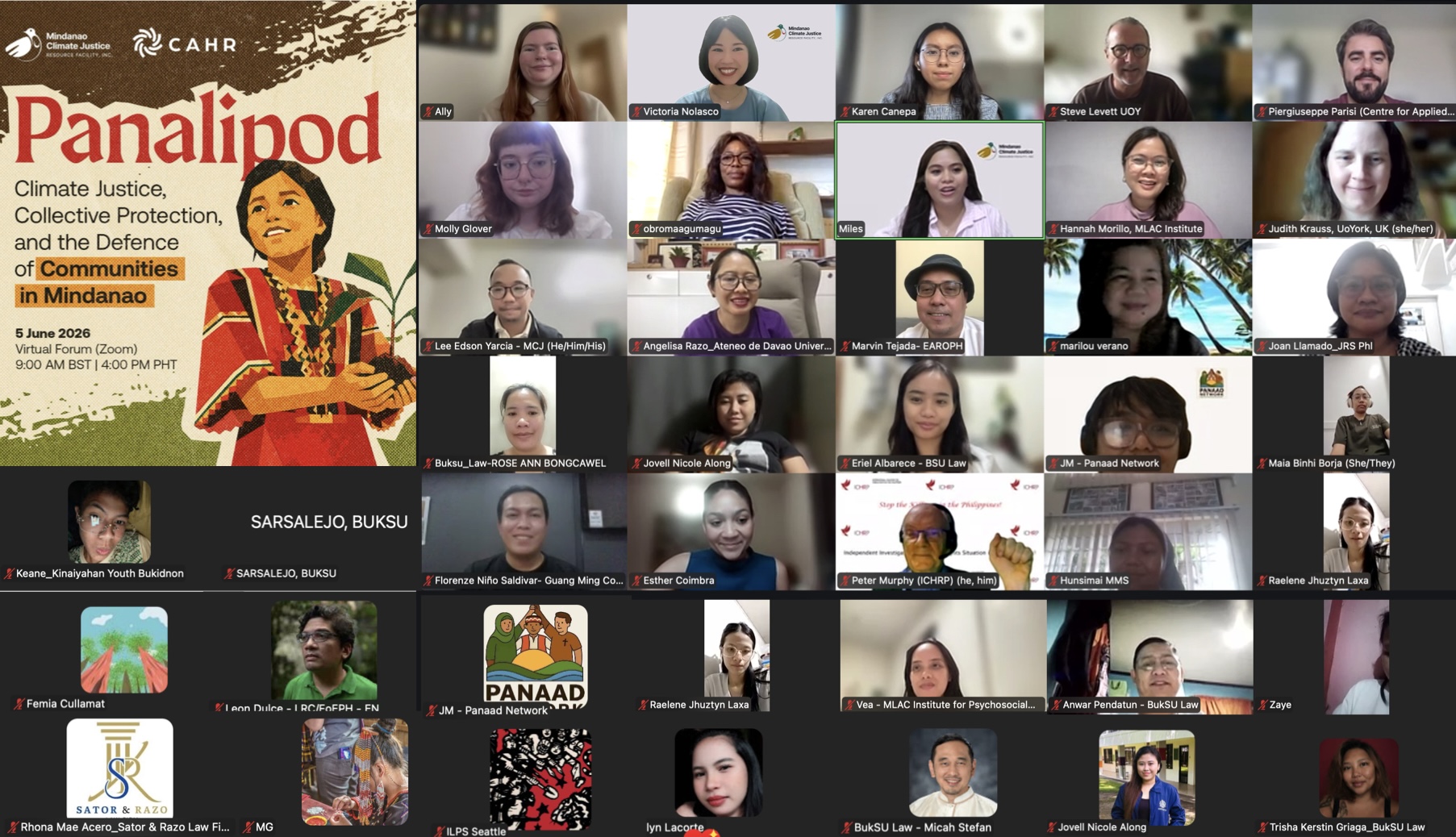
Organized by the Mindanao Climate Justice Resource Facility (MCJ) in collaboration with the Centre for Applied Human Rights (CAHR), University of York, the event served as both a reflection on the realities confronting frontline communities in Mindanao and the public presentation of the Panalipod Framework—a community-rooted protection initiative designed to strengthen collective protection for Environmental Human Rights Defenders (EHRDs) and vulnerable communities.
The forum was attended by more than 100 participants, including group participants and community viewing groups, bringing together environmental defenders, Indigenous leaders, lawyers, church workers, researchers, students, psychosocial support practitioners, and climate justice advocates from the Philippines, the United Kingdom, the United States, Mexico, Brazil, and other countries. The gathering highlighted the growing international solidarity surrounding climate justice, Indigenous rights, environmental defence, and collective protection.
As the global World Environment Day campaign calls on governments, institutions, and communities to act #NowForClimate, participants emphasized that meaningful climate action must also include protecting those who stand on the frontlines of environmental defence and climate justice.
Why Panalipod Was Developed
The Panalipod Framework emerged from years of accompaniment and engagement with Environmental Human Rights Defenders, Indigenous communities, displaced families, humanitarian workers, educators, church partners, and grassroots organizations across Mindanao. These communities continue to confront overlapping threats—from climate-related disasters and environmental destruction to militarization, displacement, criminalization, and attacks against those defending land, life, and ancestral domains.
As these challenges intensified, MCJ and its partners recognized the need for a protection framework that goes beyond emergency response and individual security measures. Panalipod was developed as a community-rooted approach that recognizes protection as a collective process grounded in solidarity, wellbeing, resilience, accompaniment, and community self-determination.
Mindanao at the Frontline of the Climate and Human Rights Crisis
World Environment Day 2026 focused on the urgency of climate action in response to escalating environmental crises across the globe. Yet for many communities in Mindanao, climate change is not a distant threat—it is a lived reality intertwined with displacement, militarization, environmental destruction, and human rights violations.
The forum took place amid worsening climate and human rights conditions in Mindanao. Communities continue to confront climate-related disasters, displacement, environmental destruction, extractive projects, militarization, and attacks against environmental defenders and Indigenous leaders.
More than 200 Lumad schools have been closed over the past decade, affecting over 100,000 Indigenous children and youth. Thousands of Indigenous families remain displaced from their ancestral lands, including the Manobo-Pulangiyon community in Bukidnon, many of whom have spent nearly a decade living in makeshift shelters along a national highway. At the same time, environmental defenders and community advocates continue to face criminalization, red-tagging, and threats for defending land, forests, watersheds, and ancestral domains.
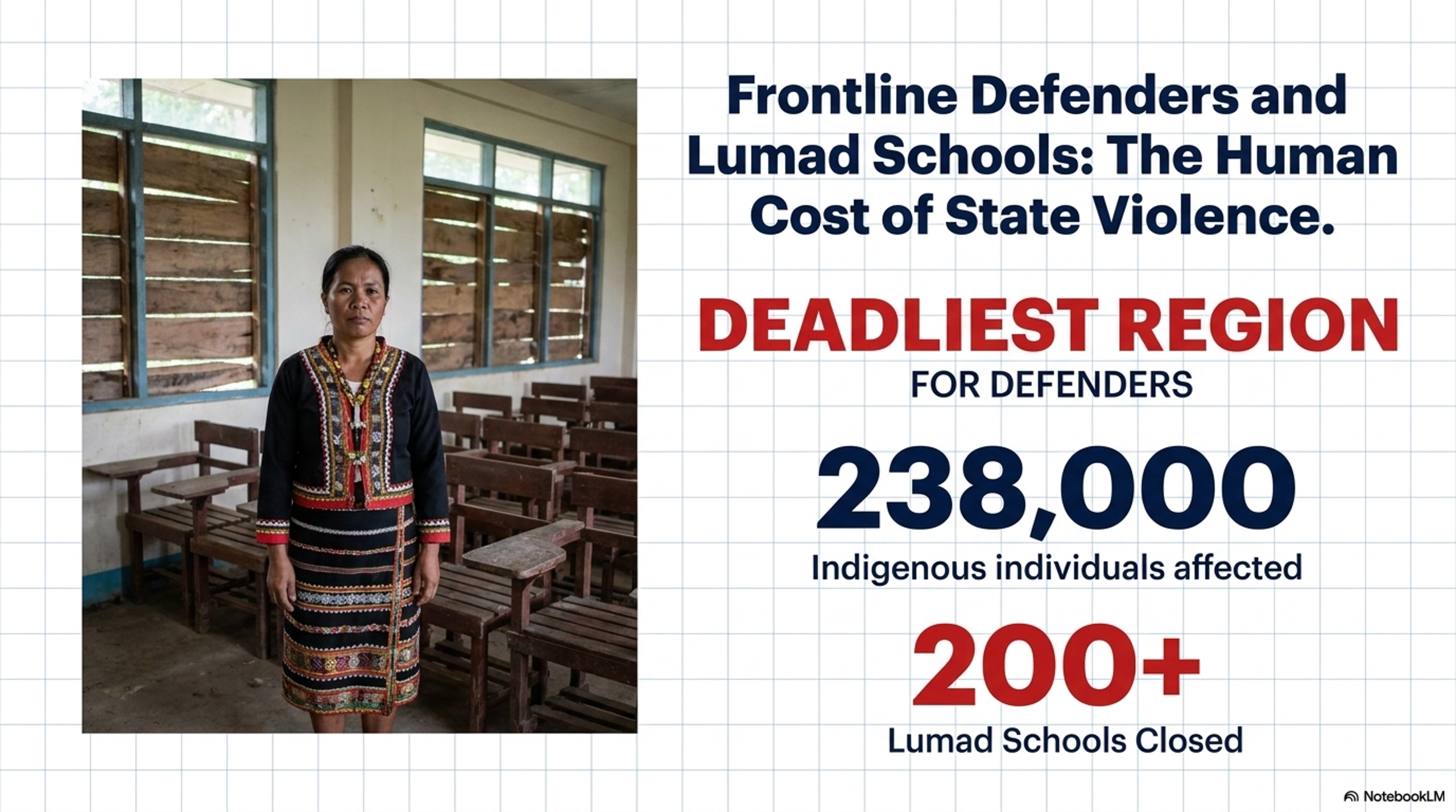
Against this backdrop, participants stressed that climate justice cannot be separated from human rights, collective wellbeing, and community protection.
Opening the discussion, Professor Pier Giuseppe Parisi, Professor at York Law School and Director of the Human Rights Defence Clinic under the Centre for Applied Human Rights (CAHR), University of York, emphasized that Indigenous communities and environmental defenders face overlapping challenges, including climate vulnerability, displacement, environmental conflict, criminalization, and threats related to the defence of land and natural resources.
“The climate crisis is not simply an environmental issue, but a question of justice, survival, and collective protection.”
Drawing from the findings of the World Inequality Report 2026, Parisi underscored that those most affected by climate change are often the least responsible for causing it.
“The climate crisis is a universal issue. Yet those who are most affected often hold the keys to a sustainable future.”
He further reminded participants that meaningful transformation begins with people and communities themselves.
“Change starts from local struggles, everyday conversations, and communities.”
When Protection Fails
Atty. Angelisa L. Razo, public interest lawyer, legal educator, and member of the Union of People’s Lawyers in Mindanao (UPLM), described what she called the “Green Paradox” in Mindanao—a situation where environmental laws and protection mechanisms exist on paper, yet communities and defenders remain highly vulnerable.
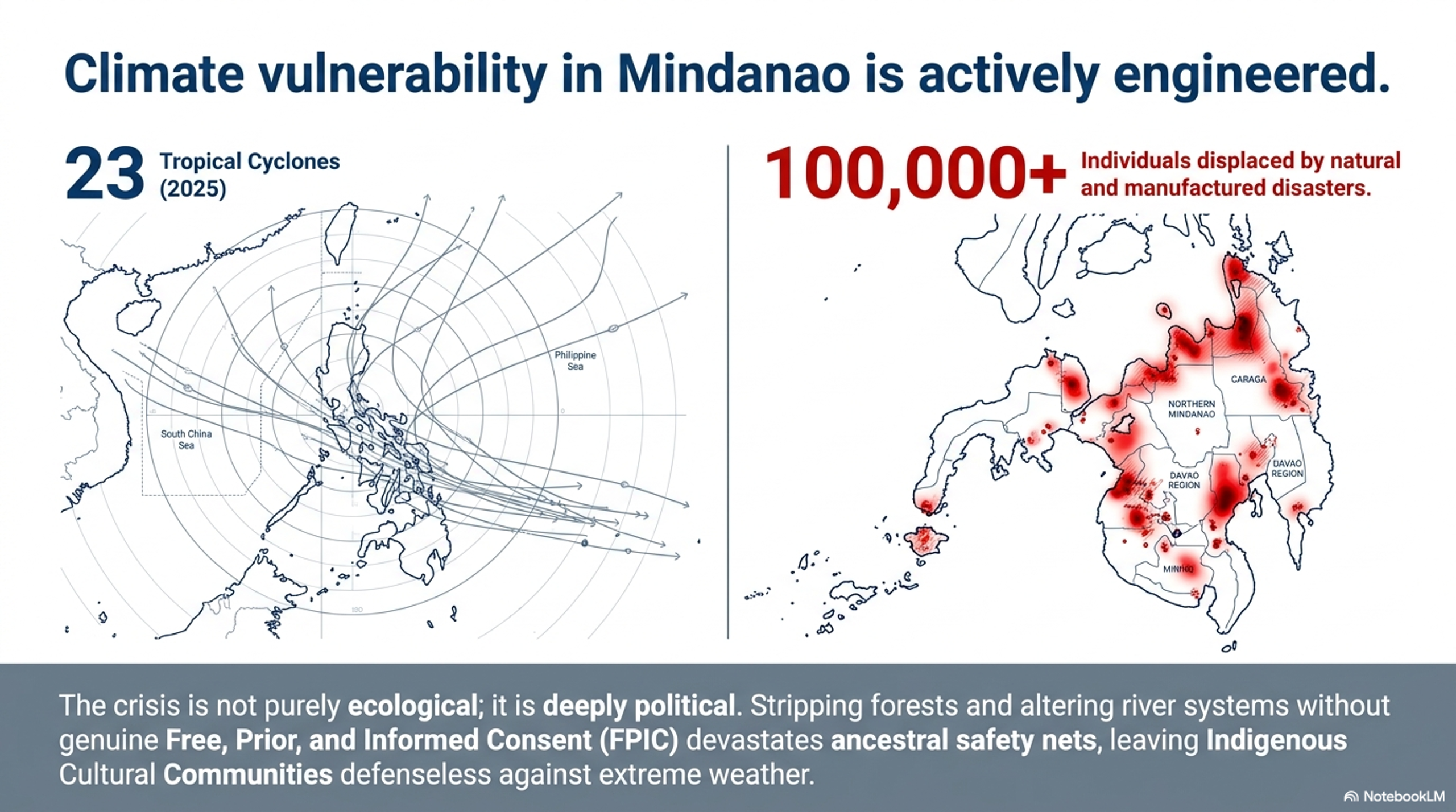
“Climate vulnerability is engineered.”
She explained how destructive development projects, weak implementation of environmental laws, and long-standing patterns of dispossession continue to undermine community resilience.
“In Mindanao, natural disasters and climate vulnerability are engineered. When you strip forests through massive logging and conduct open-pit mining without genuine free, prior, and informed consent, you are systematically devastating community resilience.”
Razo cited several emblematic cases illustrating the protection gap faced by Indigenous communities and defenders.
Among them is the continuing displacement of the Manobo-Pulangiyon community in Kiantig, Bukidnon, where nearly 1,500 families have spent almost a decade living in makeshift shelters along the Damulog–Kibawe highway after being forcibly displaced from their ancestral domain. Despite the expiration of corporate leases and legal developments supporting their claims, many continue to face threats, militarization, and denial of justice.
She also highlighted the closure of more than 200 Lumad schools, which affected over 100,000 Indigenous children and youth.
“This is not only an attack on education. It is an attack on the future of environmental stewardship itself.”
The discussion further referenced the case of the Talaingod 13, composed of Lumad educators, humanitarian workers, church people, and community volunteers. Their conviction has become one of the most prominent examples of the criminalization of Indigenous education, humanitarian action, and community protection efforts in the Philippines.
Reflecting on the role of law, Razo reminded participants:
“The law must not just be a concept that we study. It must be a shield we wield.”
She concluded with one of the forum’s strongest messages:
“There is no climate justice without human rights and there is no environmental protection without defender protection.”
Panalipod: A Community-Rooted Response
Against this backdrop, the forum formally presented the Panalipod Framework.
“Panalipod,” a Visayan term meaning “to protect,” seeks to reframe protection as a collective, holistic, and sustained process rooted in solidarity, community knowledge, wellbeing, and resilience.
Miles Gonzales, moderator of the forum and representative of Mindanao Climate Justice Resource Facility (MCJ), emphasized that protection must be understood beyond emergency response and security interventions.
“Protection cannot be understood solely as a response to immediate threats. Panalipod approaches protection as a collective and community-rooted process.”
Developed through collaboration between MCJ, the Centre for Applied Human Rights (CAHR), University of York, and community partners in Mindanao, the framework emerged from the recognition that protection cannot be limited to emergency responses or individual security measures alone.
Instead, Panalipod recognizes that environmental defenders operate within broader social, political, cultural, and ecological systems. Effective protection therefore requires community participation, psychosocial support, accompaniment, collective care, risk monitoring, and long-term institutional support.
The framework is grounded in principles of human dignity, environmental justice, confidentiality, community ownership, and the “do no harm” approach.
International Collaboration for Collective Protection
A key feature of the project was the contribution of MCJ interns and graduate researchers from the Human Rights Defence Clinic and the Centre for Applied Human Rights (CAHR), University of York.
The research component was led by:
- Molly Glover (United Kingdom) – LLM candidate in International Human Rights Law and Practice.
- Alesha Sparks (United Kingdom) – MA candidate in International Human Rights Law.
- Brandie Brown (United States) – Juris Doctor candidate and human rights researcher.
- Karen Canepa (Mexico) – Lawyer and LLM candidate specializing in migration and human rights.
- Esther Olimpia Coimbra (Brazil) – Human rights lawyer and researcher focusing on migration, refugee protection, and the protection of human rights defenders.
Working alongside MCJ, Environmental Human Rights Defenders, community advocates, and protection practitioners, the researchers examined protection models, governance mechanisms, risk monitoring systems, and sustainability strategies that informed the development of the Panalipod Framework.
Presenting the conceptual foundations of the framework, Molly Glover argued that conventional approaches to protection often overlook the relationship between communities and the broader systems that affect them.
“The issues we discuss happen in the gap between the spaces where decisions are made and the communities those decisions affect.”
She emphasized that Panalipod rejects an individualized approach to protection.
“Panalipod sees protection as a community condition, not a bodyguard contract.”
She further stressed the inseparable connection between environmental protection and defender protection.
“Defender protection is ecosystem protection.”
Meanwhile, Alesha Sparks highlighted the importance of broadening how risks are understood.
“Threats to defenders are not only physical. They can be legal, psychosocial, economic, informational, and community-based.”
She emphasized that monitoring should function as an early-warning and collective response system, rather than merely a documentation tool.
Likewise, Brandie Brown stressed that risk assessments must lead to action.
“A risk assessment is not just a tool for identifying threats but a tool for informing action.”
Focusing on governance and sustainability, Esther Olimpia Coimbra stressed that long-term protection requires more than individual commitment.
“Protection requires structures that can coordinate, learn, adapt, and respond.”
She added:
“Sustainable protection depends on governance, not only goodwill.”
Similarly, Karen Canepa highlighted the importance of partnerships and institutional collaboration.
“Communities remain at the center, but protection is strengthened through networks of support.”
According to Canepa, meaningful protection requires collective responsibility among communities, civil society organizations, faith-based groups, universities, and solidarity networks.
“Effective protection depends on relationships, coordination, and shared responsibility.”
Reflections from Experts and Practitioners
Following the presentations, a panel of experts offered reflections on the framework and its broader implications.
Professor Stephen Levett, York Law School and member of the Centre for Applied Human Rights (CAHR), University of York, welcomed Panalipod’s recognition of collective care and community-based approaches.
Reflecting on the framework, he posed a critical question:
“What do we mean when we say community?”
His intervention encouraged participants to think carefully about the diverse realities, relationships, and responsibilities that shape community protection efforts.
Hannah Morillo, Executive Director of the MLAC Institute for Psychosocial Services, emphasized that psychosocial wellbeing must be treated as a central component of protection.
“There can be no real healing without embodied safety.”
She further stressed that responsibility for safety cannot rest solely on affected individuals.
“Safety must also be demanded from the systems that are supposed to protect and care for us.”
Dr. Judith Krauss, Lecturer in Politics and International Relations at the University of York and researcher on environmental justice, sustainability, and socio-environmental conflicts, encouraged participants to examine how climate vulnerability intersects with gender, ethnicity, class, colonial histories, and political marginalization.
She emphasized that effective protection frameworks must recognize diverse realities and account for intersectionality, ecofeminist perspectives, and decolonial approaches to environmental justice.
Meanwhile, Atty. Lee Edson P. Yarcia, MD, JD, Board Member of Mindanao Climate Justice Resource Facility (MCJ), public health advocate, and legal practitioner, reflected on Panalipod as both a framework and a call to action.
“Protection means there is something worth protecting.”
He concluded by reminding participants that environmental protection and community protection are inseparable.
“To protect the environment is also to protect the people and communities whose lives are bound to it.”
Looking Forward
As the forum concluded, participants returned to a simple but urgent message: climate action cannot be separated from the protection of those defending land, life, and ecosystems.
Environmental defenders, Indigenous leaders, humanitarian workers, educators, faith-based actors, and community advocates are not merely people at risk. They are essential actors in safeguarding biodiversity, protecting ancestral lands, defending human rights, and advancing climate justice.
The launch of Panalipod serves as a reminder that protecting communities is not only a human rights imperative—it is a climate justice imperative.
As climate disasters intensify and attacks against defenders continue, the challenge is no longer simply how to respond to crises. The challenge is how to build systems of care, solidarity, accompaniment, and protection capable of sustaining communities for generations.
Through Panalipod, MCJ, the Centre for Applied Human Rights (CAHR), University of York, and their partners hope to contribute to that collective effort by strengthening community resilience, advancing collective protection, and supporting those who continue to defend land, life, dignity, and the environment.
Because there can be no climate justice without human rights, and there can be no environmental protection without protecting those who defend the environment.
As Atty. Angelisa L. Razo reminded participants:
“There is no climate justice without human rights and there is no environmental protection without defender protection.”
And as the forum repeatedly affirmed:
“A just transition that does not protect communities is not a just transition.”
In a world increasingly shaped by climate uncertainty and environmental conflict, Panalipod offers more than a framework for protection. It offers a vision of how communities, institutions, and solidarity networks can work together to defend life, dignity, and the future.